Copán is one of the most important sites of the Maya civilisation and a UNESCO World Heritage Site since 1980. Known as the Paris of the Maya world for the quality of its sculpture, it represents the high point of Maya artistic expression.
The history
Copán was the capital of a significant Maya kingdom through the Classic period, from the fifth to the ninth century AD. At its height the city held perhaps 20,000 to 25,000 people and was an important political, ceremonial and scientific centre.
It was ruled by a dynasty of sixteen kings, beginning with K’inich Yax K’uk’ Mo’ in 426 AD. The most celebrated was the thirteenth, Waxaklajuun Ub’aah K’awiil — known as 18 Rabbit — who built many of the monuments still standing.
The city was abandoned around 900 AD for reasons still debated — overpopulation, warfare, climate change — and the forest covered it for centuries until it was rediscovered in the nineteenth century.
What to see on the site
The Hieroglyphic Stairway
The jewel of Copán and the longest Maya inscription ever found. Sixty-three steps carrying more than 2,500 individual glyphs that tell the full history of the Copán dynasty. It was completed in 755 AD by the fifteenth king.
It stands about 20 metres high and 10 wide, and is now protected under a canopy.
The Great Plaza and the stelae
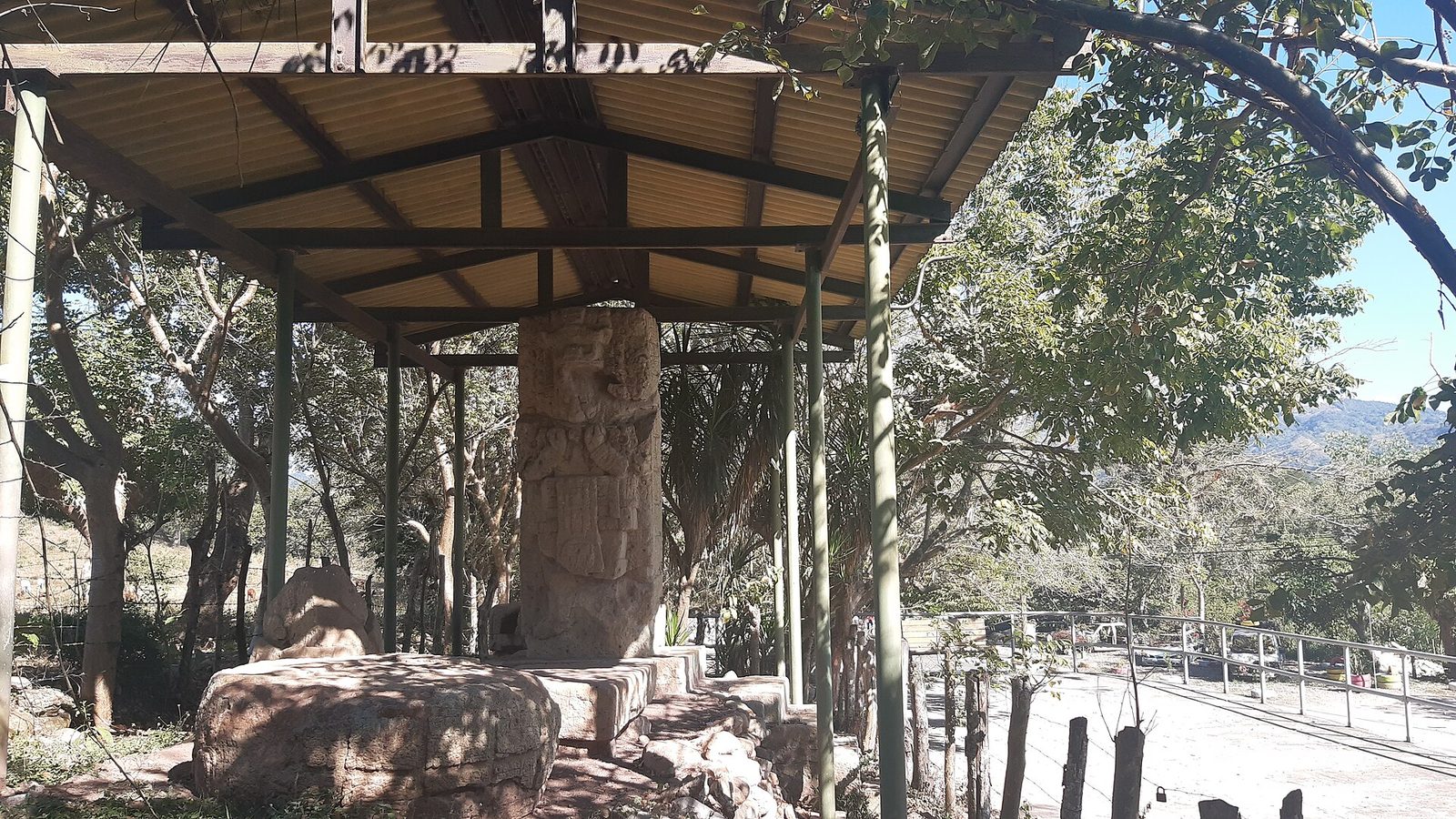
The Great Plaza holds some of the most impressive stelae in the Maya world — tall carved stones portraying Copán’s rulers with extraordinary precision. Stela A shows 18 Rabbit in an elaborate headdress; Stela B the same king dressed as a ball player; Stela C is carved on both faces.
The depth of the carving here is what sets Copán apart from every other Maya city: the figures are almost fully three-dimensional.
The ball court
One of the best preserved in the Maya world, with macaw-head markers along its sloping walls.
The Rosalila temple and the tunnels
The Maya built new temples over old ones, and at Copán archaeologists tunnelled in to reach them. Rosalila was found almost intact with its original paint, and a full-size replica stands in the site museum. A separate ticket lets you walk a section of the tunnels themselves.
The sculpture museum
Worth the extra entry. Many original carvings were moved here to protect them from the weather, and the Rosalila replica gives you the colour the ruins have lost.
Scarlet macaws
Honduras’s national bird lives in the trees around the entrance, part of a reintroduction programme. They are loud, unmissable and entirely used to visitors.
The village
Copán Ruinas, a kilometre from the site, is a genuinely pleasant colonial village with a cobbled square, hotels at every budget, restaurants and craft shops. Most people stay a night or two rather than rushing through.
Nearby are hot springs, a bird park, coffee farms and the smaller site of Las Sepulturas, where the nobility lived.
Getting there
Copán sits close to the Guatemalan border. From Antigua or Guatemala City there are direct shuttles, which is how many travellers arrive. From San Pedro Sula it is about three hours by road.
Practical advice
- Go early. The site opens in the morning, the light is better and the heat is bearable.
- A guide is genuinely worth it here: without one the glyphs mean nothing.
- Site, museum and tunnels are separate tickets.
- Allow three to four hours for the ruins and museum.
- Repellent and sun protection; the plaza has little shade.