Deep in the Petén jungle sits Tikal, the largest Maya city ever uncovered and one of those places that leaves you without much to say. Pyramids of 70 metres rising above the canopy, howler monkeys as a soundtrack, and 5,000 ancient structures spread across 16 km².
A UNESCO World Heritage Site inside a protected area of 575 km², Tikal is not only archaeology: it is wilderness, and one of the most intense experiences in Central America.
The history
Tikal was one of the most powerful cities of the Classic Maya world. At its height, between roughly 200 and 900 AD, it may have held 100,000 people, making it one of the largest cities on earth at the time.
It was abandoned around 900 AD, along with many other Maya cities, for reasons still argued over. The jungle swallowed it for centuries until it was rediscovered in 1848. Only about 5% of the site has been restored, which means thousands of structures are still under the vegetation — the wooded mounds you walk past are buildings.
What to see
The Great Plaza
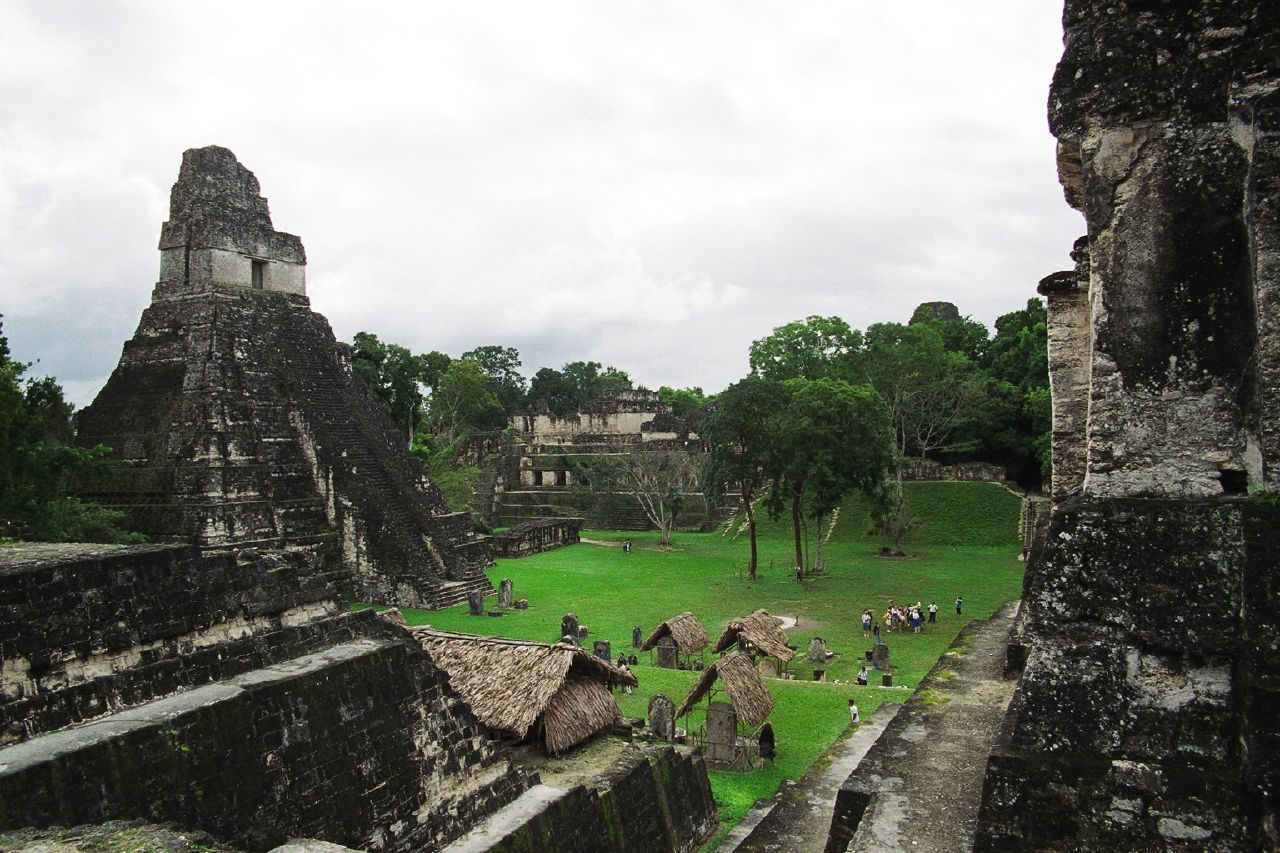
The ceremonial heart. Here stand Temple I, the Temple of the Great Jaguar, a 47-metre pyramid that was the tomb of king Jasaw Chan K’awiil, and Temple II, the Temple of the Masks, at 38 metres. The contrast between the monumental stonework and the jungle pressing in on all sides is the image people carry away.
Temple IV
The tallest structure at around 70 metres, and the one you can climb — by wooden staircase up the back. From the top you look out over an unbroken canopy with the crowns of the other temples poking through. It is the view used in the original Star Wars.
Mundo Perdido and the Lost World
The oldest complex on the site, built around an astronomical observation pyramid. Quieter than the Great Plaza and, for many people, more atmospheric.
Wildlife
Tikal is a serious wildlife site in its own right: howler and spider monkeys, coatis wandering the plazas, ocellated turkeys with iridescent plumage, toucans and, with luck, grey foxes. Go early and you will see far more.
The sunrise tour: is it worth it?
It means leaving Flores around 3 in the morning, paying a supplement and climbing Temple IV in the dark to watch dawn over the canopy.
Honestly: in Petén the mornings are frequently misted over, and you may see nothing but white. What you will reliably get is the sound — the jungle waking up, with howler monkeys starting a roar you feel in your chest. That alone is worth it for many people. If you want a guaranteed view, go at normal opening time instead.
Getting there
Almost everyone stays in Flores, on its island in Lake Petén Itzá, about an hour and a half from the site by shuttle. Flores connects by air with Guatemala City and by long night bus with the rest of the country.
There are also a few hotels at the park entrance, which is the only way to be inside at opening or closing time.
Practical advice
- Go early. The heat and humidity in Petén are serious by midday.
- Take at least two litres of water, repellent and closed shoes.
- A guide for the first couple of hours transforms the visit; afterwards you can wander alone.
- Allow four to six hours. The site is large and the walking between complexes adds up.
- Yaxhá, an hour away, is a fine second site with almost nobody in it.