Few cities offer a contrast this brutal in a single glance: from any rooftop in Casco Antiguo you see eighteenth-century wooden balconies in the foreground and, across the bay, a wall of glass towers. That clash is the best definition of Panama City there is.
The neighbourhood has been a World Heritage Site since 1997 and has gone from run-down to the centre of the capital’s nightlife and cooking. You can walk all of it in a morning, though it deserves longer.
Why Casco Antiguo exists
The first Panama City, founded in 1519, was not here. It stood a few kilometres east and the pirate Henry Morgan destroyed it in 1671. The survivors founded a new city in 1673 on a peninsula that was easier to defend, walled, with the sea as a natural moat. That is the Casco.
The ruins of the original city, Panamá Viejo, are still standing and are also a World Heritage Site. Its cathedral tower is one of the country’s emblems.
What to see
Plaza de la Independencia
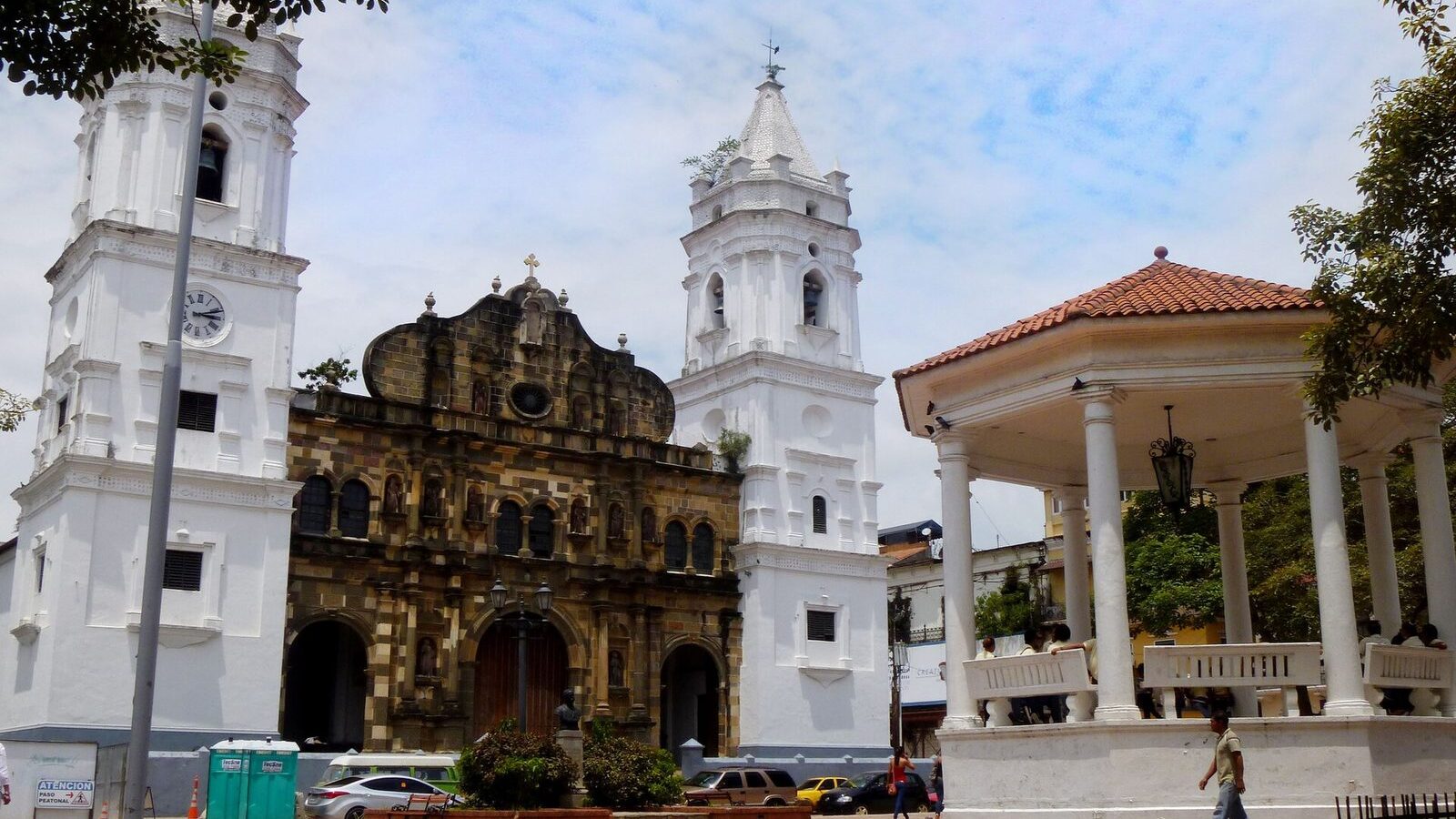
The heart of the quarter, presided over by the cathedral of Santa María la Antigua with its two towers inlaid with mother-of-pearl. Around it stand the Interoceanic Canal Museum and some of the best-restored buildings in the district.
Plaza de Francia and Las Bóvedas
At the tip of the peninsula, dedicated to the French who tried to build the canal before the Americans and failed at an enormous human cost. The vaults of the old barracks beneath the promenade now hold galleries and restaurants. The upper walkway runs right around the point, facing open sea.
Santo Domingo and the Flat Arch
Here stands the Arco Chato, an almost flat brick arch that held for centuries without support and which, the story goes, was used as evidence that Panama had no earthquakes and would make a good site for a canal. It collapsed in 2003 and has been rebuilt.
San José and the Golden Altar
A baroque altarpiece covered in gold leaf which, tradition holds, escaped Morgan’s sacking because the friars painted it black to disguise it. It is the most photographed thing inside the quarter.
The rooftops
The most Panamanian experience in the Casco: climb to a roof terrace at dusk and watch the towers light up across the water. Nearly every hotel in the quarter has a rooftop bar and most admit visitors who order a drink.
Panamá Viejo
About twenty minutes by car from the Casco, towards the airport. What remains is a set of stone ruins in a park beside the sea: the cathedral with its tower, the Concepción convent, the King’s Bridge and the outline of the city burned in 1671. The site museum lays out the sequence well.
You can climb the tower, and from the top the geography makes sense: the old city facing the Pacific, with the modern skyline cut out behind it.
Where to eat
The Casco holds the best food in the capital, from set-lunch fondas to high-end Panamanian cooking. For something quick and local, look for the fondas on the inner streets, away from the main squares, where people who work in the neighbourhood eat.
Fifteen minutes away is the Mercado de Mariscos, worth the trip: cups of fresh ceviche at market prices and a row of kitchens upstairs that will cook whatever fish you pick downstairs.
Practical advice
- Shoes: the cobbles are uneven and restoration work is constant. No heels.
- Timing: the quarter is far better early in the day and at dusk. At midday the sun and humidity punish.
- Safety: the tourist perimeter is heavily policed, but the streets along the northern edge change character at night. Take a car after a certain hour.
- Shopping: the Guna molas sold at the stalls are genuine craft. Haggle gently and look at the stitching.
- How long: half a day for the essentials, a full day with Panamá Viejo and a rooftop at sunset.