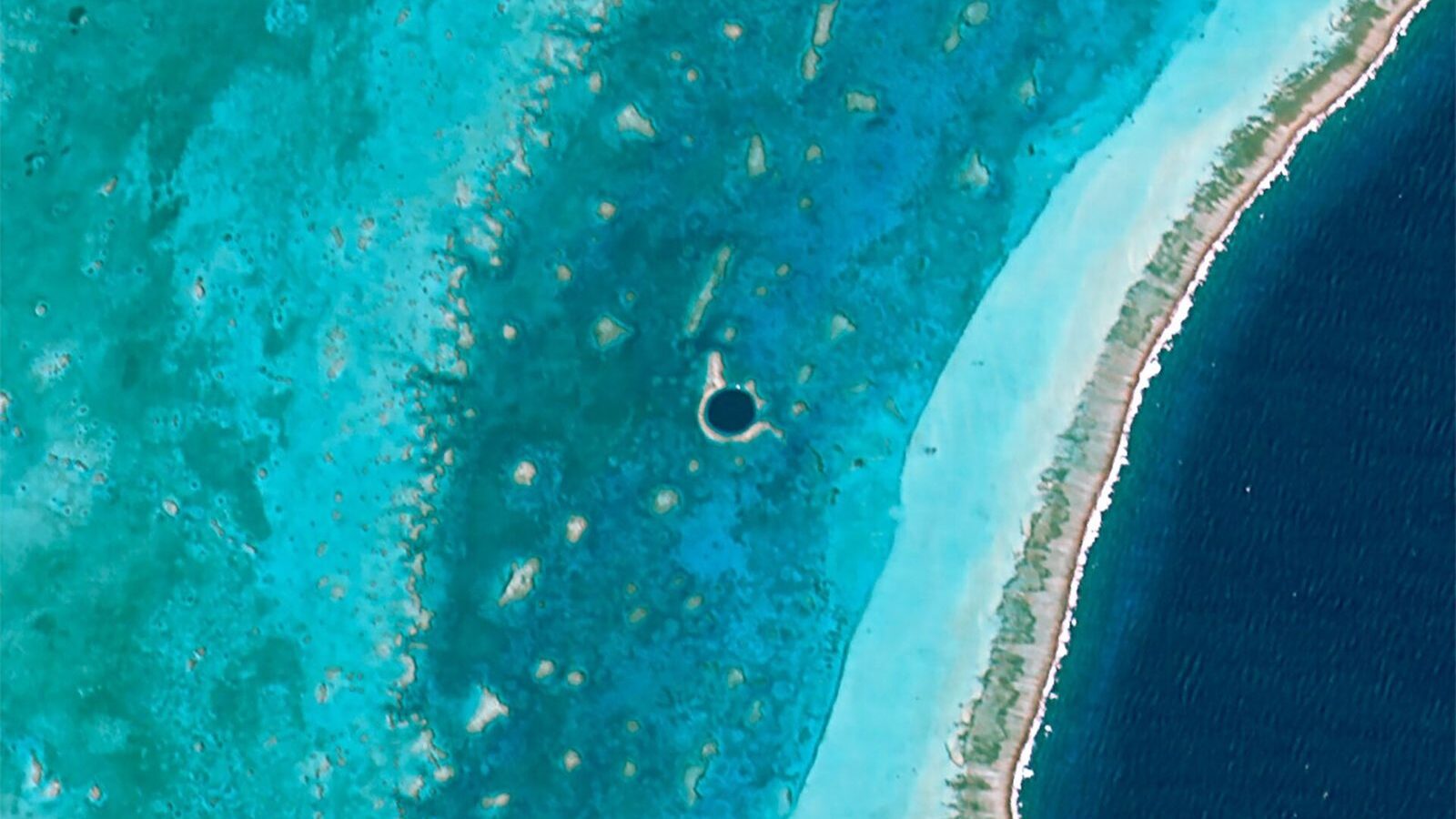
From the air it is a perfect navy circle cut into a turquoise reef, as if someone had punched a hole in the sea. The Great Blue Hole is the image that sells Belize, and one of the few that does not disappoint.
That said: diving it is not what many people imagine. It is worth knowing what is actually down there before you spend the money.
What it actually is
It is not a reef or a crater: it is a collapsed limestone cave. During the ice ages, when sea level was far lower, this was a dry cave full of stalactites. As the sea rose the cave flooded and the roof fell in, leaving a circular sinkhole.
It measures a little over 300 metres across and around 120 metres deep. It sits on Lighthouse Reef atoll, roughly 70 kilometres offshore, inside the World Heritage area. Jacques Cousteau explored it with the Calypso in 1971 and made it famous worldwide.
Diving it
What you see
The dive descends to about 40 metres to see the giant stalactites hanging at an angle, the proof that this was once a dry cave. Caribbean reef sharks usually appear, circling out in the blue.
Be realistic: at that depth there is little light, little colour and essentially no coral. It is a geological and atmospheric dive, not a marine life one. Plenty of divers come up saying the other two dives of the day, at Half Moon Caye and Long Caye, were better.
Requirements
It is a deep dive and serious operators require at least Advanced Open Water certification or equivalent, plus a minimum number of logged and recent dives. Some ask for a deep diving specialty.
This is not a dive to do with a brand-new certificate. Bottom time is very short, there is narcosis at that depth and air consumption climbs steeply.
What the day looks like
A full-day trip leaving before dawn from Caye Caulker, San Pedro or Belize City. Two to three hours of navigation each way, three dives, and a stop at Half Moon Caye, where there is a red-footed booby colony.
The crossing can be rough. If you get seasick, take something the night before and again on waking.
Flying over it
If you do not dive, this is the better option and, for many people, the more impressive one: the Blue Hole reads far better from above than from inside. Flights last about an hour, leave from Belize City or San Pedro in a light aircraft, and make several passes so every seat gets a window.
Ask for a window seat and go around midday with the sun high: that is when the contrast between the blues is strongest. Under cloud it loses a lot, so some flexibility on dates helps.
Snorkelling
You can ride out on the divers’ boat and snorkel the rim, but from the surface all you see is the change in colour. The good snorkelling on that trip is at Half Moon Caye and Long Caye, not the hole itself.
If snorkelling is your thing, your money goes much further at Hol Chan and Shark Ray Alley near San Pedro, where the reef is alive and only a few metres down.
Practical advice
- Do not fly after diving for at least 18 hours. Plan your departure day around it.
- There is a marine park fee that is almost never included in the advertised price. Ask.
- The dry season, December to May, brings flatter seas and better visibility.
- Choose a dive centre on its record and its guide-to-diver ratio, not on price.
- Bring mineral sunscreen: the chemical kind damages coral and is restricted in several areas.